• Samstag, 19. Juni 2027<br/> 19.30 Uhr Vaduz (FL) <br/><br/> Orgelkonzert

    Samstag, 19. Juni 2027
    19.30 Uhr Vaduz (FL)

    Orgelkonzert

    Vaduz - Kathedrale Sonntag, 4. Juli 2027, 18.00 Uhr Orgelkonzert Programm Johann Sebastian Bach Die Kunst der Fuge (1750) (1685-1750) Fuge Nr. 1 Fuge Nr. 18 (Ergänzung durch Alexandre F. Boëly) César Franck Choral a.Moll (1890) (1822-1890) Olivier Messiaen Livre du Saint Sacrement (1984), daraus (1908-1992) Prière (Nr. 16) Josef Gabriel Rheinberger Sonate A – Dur op. 188 (1901) (1839 – 1901) Präludium Intermezzo Pastorale Finale Rudolf Innig, Orgel (www.rudolf-innig.de) Gedanken zur Musik

    Details

  • Sonntag, 4. Juli 2027<br/> 18.00 Uhr Coesfeld <br/><br/> Orgelkonzert

    Sonntag, 4. Juli 2027
    18.00 Uhr Coesfeld

    Orgelkonzert

    Coesfeld St. Jacobi Sonntag, 4. Juli 2027, 18.00 Uhr Orgelkonzert Programm Johann Sebastian Bach Die Kunst der Fuge (1750) (1685-1750) Fuge Nr. 1 Fuge Nr. 18 (Ergänzung durch Alexandre F. Boëly) César Franck Choral a.Moll (1890) (1822-1890) Olivier Messiaen Livre du Saint Sacrement (1984), daraus (1908-1992) Prière (Nr. 16) Josef Gabriel Rheinberger Sonate A – Dur op. 188 (1901) (1839 – 1901) Präludium Intermezzo Pastorale Finale Rudolf Innig, Orgel (www.rudolf-innig.de) Gedanken zur Musik

    Details

  • Freitag, 27. August 2027<br/> 20.00 Uhr Lüneburg<br/><br/> Orgelkonzert

    Freitag, 27. August 2027
    20.00 Uhr Lüneburg

    Orgelkonzert

    Orgelkonzert St. Nicolai Lüneburg Freitag, 28. August 2026, 20.00 Uhr Programm: Max Reger Fantasie über B-A-C-H op 46 (1900) (1877-1916) Felix Mendelssohn Sonate c-Moll op 65 Nr. 2 (1844) (1809-1847) Grave-Adagio Allegro maestoso e vivace Fuge (Allegro moderato) Felix Nowowiejski Sinfonie e–Moll op. 45 Nr. 5 (1929) (1877 – 1946) Allegro serioso Andante ('Stella matutina' - 'Morgenstern') Passacaglia Rudolf Innig, Orgel

    Details

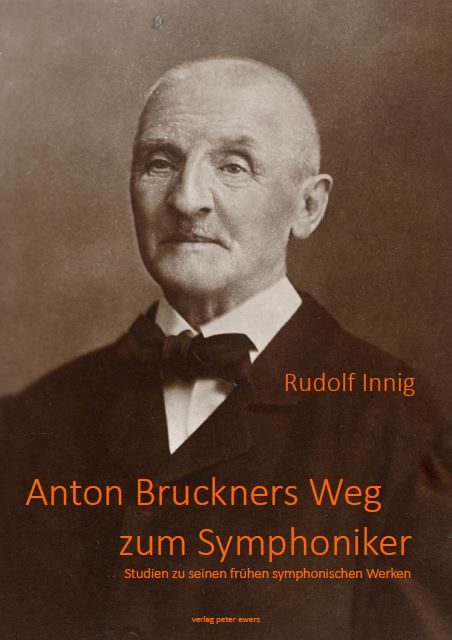
Anton Bruckner's path to becoming a symphonic composer

532 pages
(Text volume: 386 pages with many musical examples
Appendix: 148 pages with transcriptions from the Kitzler study book)

On the basis of the Kitzler study book, which was only published in 2014, Rudolf Innig presents a detailed analysis of Anton Bruckner's early symphonic works for the first time. In musical life and in Bruckner literature, they have so far received little attention and are underestimated as study works.

The author, known for his numerous CD recordings, proves that the essential characteristics of Bruckner's symphonies are already pronounced in his first symphony in F minor. The quality of his music can be demonstrated here just as is the proverbial case with the symphonies of Johannes Brahms.

Bruckner's first symphonic works are not youthful works, he composed them at the age of 39, when he was already past his middle age.

The analyzes of the symphonic works are preceded by four introductory chapters:

on Bruckner's earlier compositions (mostly sacred music), which make up more than half of his entire output,
to the music-theoretical works that Bruckner knew and which form the intellectual background of his music, so to speak,
on his working techniques and the question of the order in which the various working steps were taken in order to create his symphonic compositions, and finally
on Anton Bruckner as an organist with informative details about his teaching activities at the Vienna Conservatory and his improvisation sketches that have survived.


532 pages (Text volume: 386 pages with many musical examples
Appendix: 148 pages with transcriptions from the Kitzler study book)
15X29cm, Cardboard binding with thread sealing